Fold Clothes
Baseline - Failed
+IDR - Successful
Deformable object manipulation — fold clothes
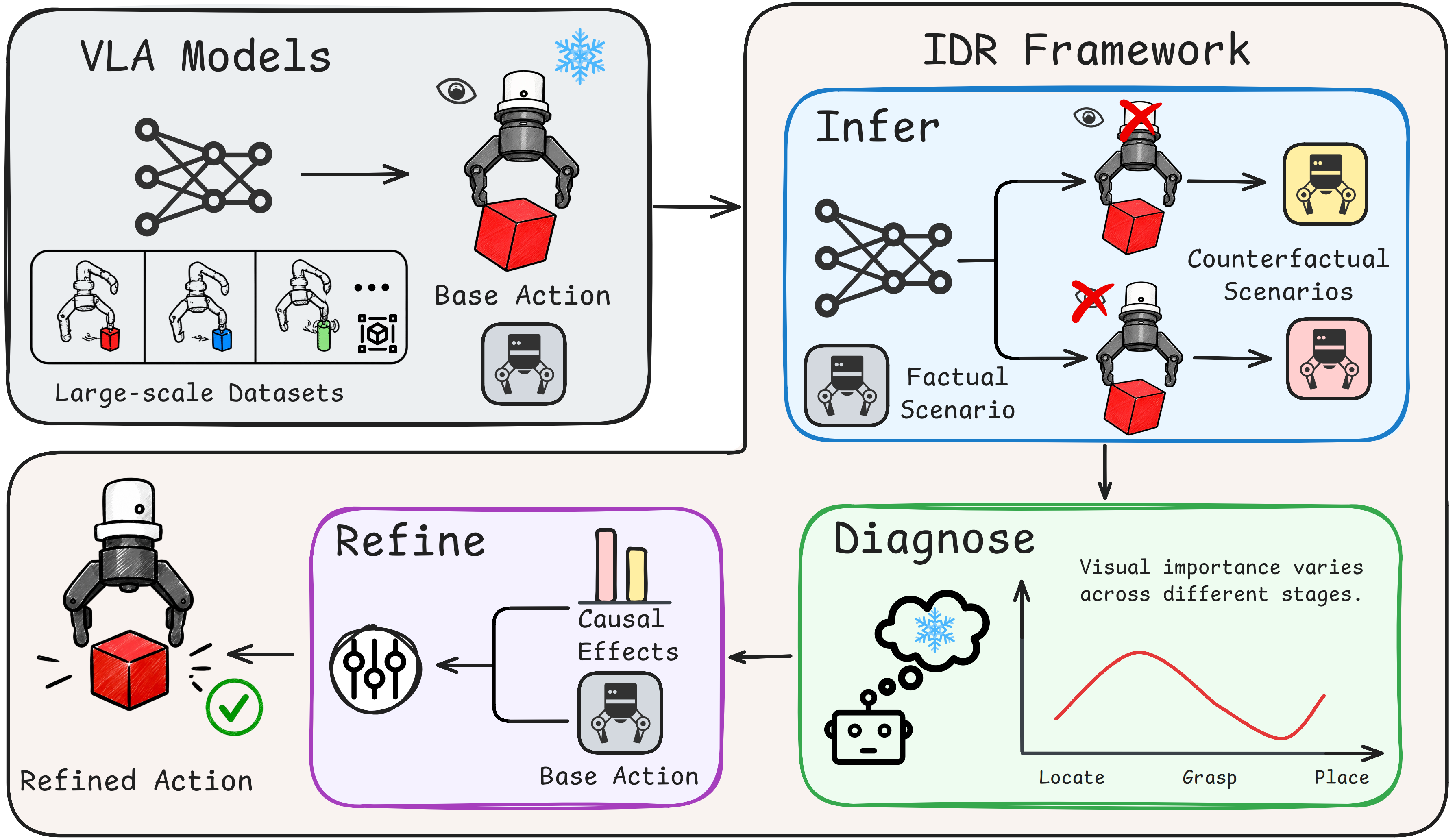
Vision-language-action (VLA) models predict sequential actions to execute tasks specified by language instructions, conditioned on visual observations and proprioceptive states. However, how to fuse modalities in VLA models remains an open problem, since robot manipulation involves dynamic phases, such as long-distance movements and close-range interactions, in which the importance of visual observations may vary over time.
In this paper, we propose an Infer-Diagnose-Refine (IDR) framework, a model-agnostic framework that can be integrated with diverse VLA architectures for refining action predictions at test time. IDR first infers actions under factual and counterfactual scenarios of visual observations, and then diagnoses the causal effects of visual observations as the estimated dynamic importance, which is finally used to refine the action predictions in a training-free manner. We further design a causality-aware action refiner to realize the IDR framework, including zero-padding interventions for inferring counterfactual actions, norm-based quantification for diagnosing causal effects, and gated residual fusion for refining actions. Extensive experiments on both simulation benchmarks and real-world tasks show improvements in overall performance across multiple VLA backbones, demonstrating the efficacy of dynamically adjusting visual importance at test time.
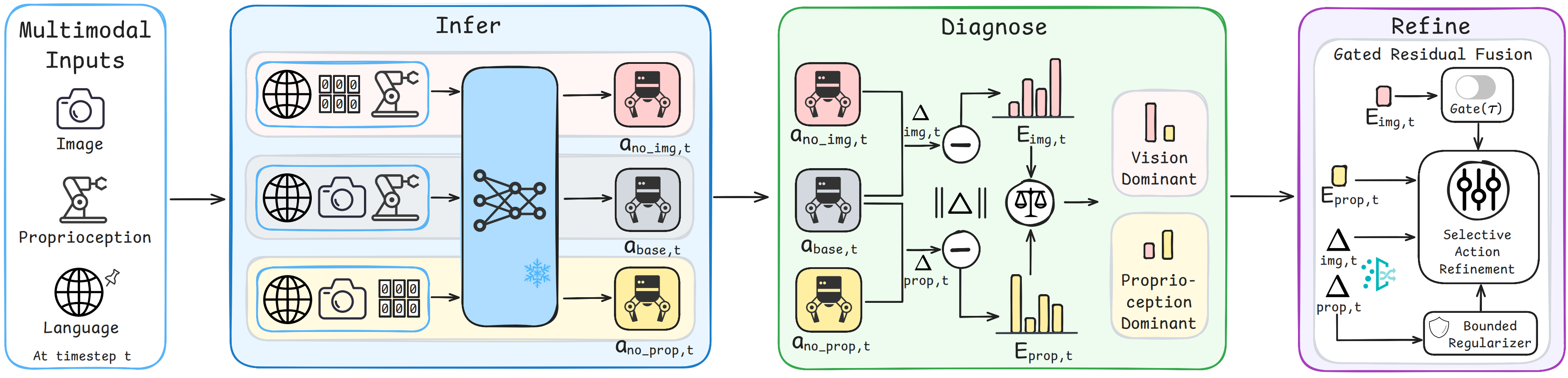
IDR Framework Architecture: Zero-padding interventions for counterfactual inference, norm-based effect quantification, and gated residual fusion.
Infer: IDR constructs counterfactual inputs through zero-padding interventions, enabling the frozen VLA model to infer factual and counterfactual outputs under different modality conditions.
Diagnose: The changes of outputs are quantified with a norm-based effect measurement to diagnose the dynamic importance of visual observations.
Refine: The diagnosed effects are integrated with the initial action prediction through gated residual fusion, producing a refined action while preserving low-level control stability.
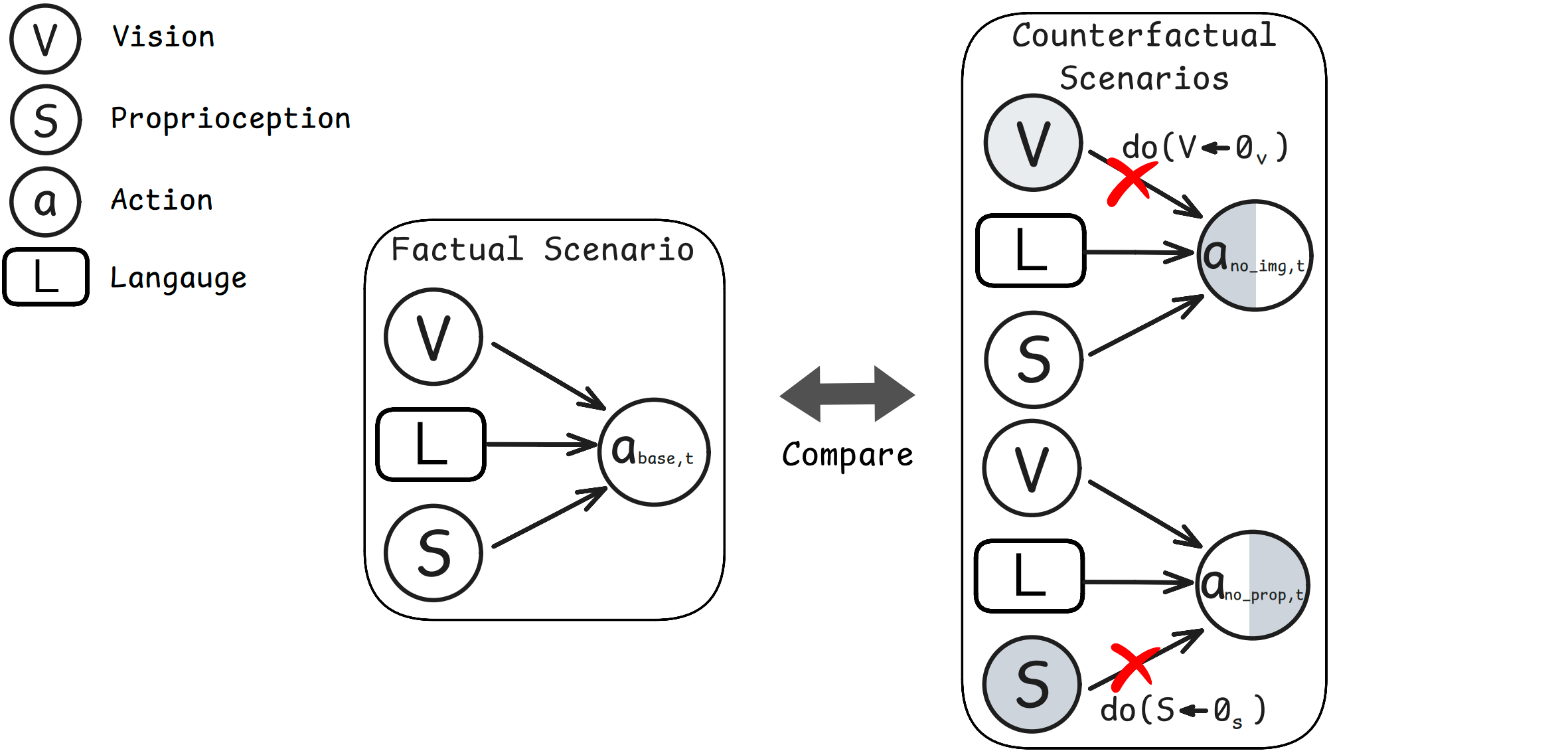
Causal graph illustrating the modality intervention framework.
IDR treats visual importance as a dynamic factor during execution, diagnoses how visual observations causally affect the current prediction, and refines the action accordingly.
Through test-time causal inference across models and environments, we derive three key observations. To compare visual effects across models and action scales, we compute the normalized visual effect ratio Rimg = Eimg / (Eimg + Eprop + ε).
| Environment | Suite/Task | Eimg | Eprop | Rimg |
|---|---|---|---|---|
| LIBERO | All suites | 0.67 | 1.59 | 29.7% |
| WidowX | Real-robot tasks | 0.62 | 0.76 | 44.9% |
| CALVIN | ABC→D | 0.61 | 0.60 | 50.7% |
| SIMPLER | Google Variant Aggregation | 1.18 | 0.09 | 93.2% |
| SIMPLER | Google Visual Matching | 0.99 | 0.07 | 93.8% |
The same VLA model (X-VLA) shifts its visual effect pattern substantially across different benchmarks or embodiments. X-VLA is proprioception-primary in LIBERO but becomes vision-dominant in SIMPLER. This environment-dependent shift suggests that modality balance is also associated with deployment environments.
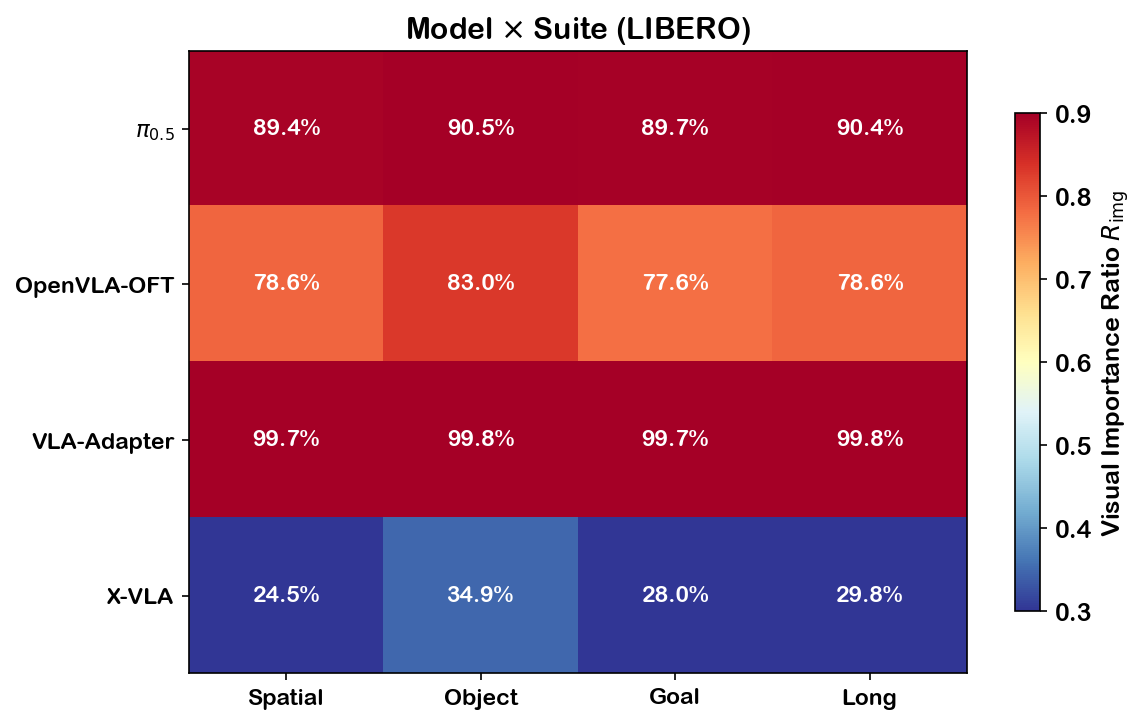
Rimg heatmap across models and LIBERO suites. Each model maintains a consistent visual effect pattern.
Within the same benchmark, different VLA models exhibit significantly different causal effect patterns. This variation reflects architectural designs where models relying heavily on a dominant vision-language space maintain a higher Rimg, while architectures that inject proprioceptive states and action tokens earlier show stronger proprioceptive effects. As shown in the figure, π0.5 and OpenVLA-OFT are vision-heavy, X-VLA is proprioception-primary, and VLA-Adapter is vision-dominant.
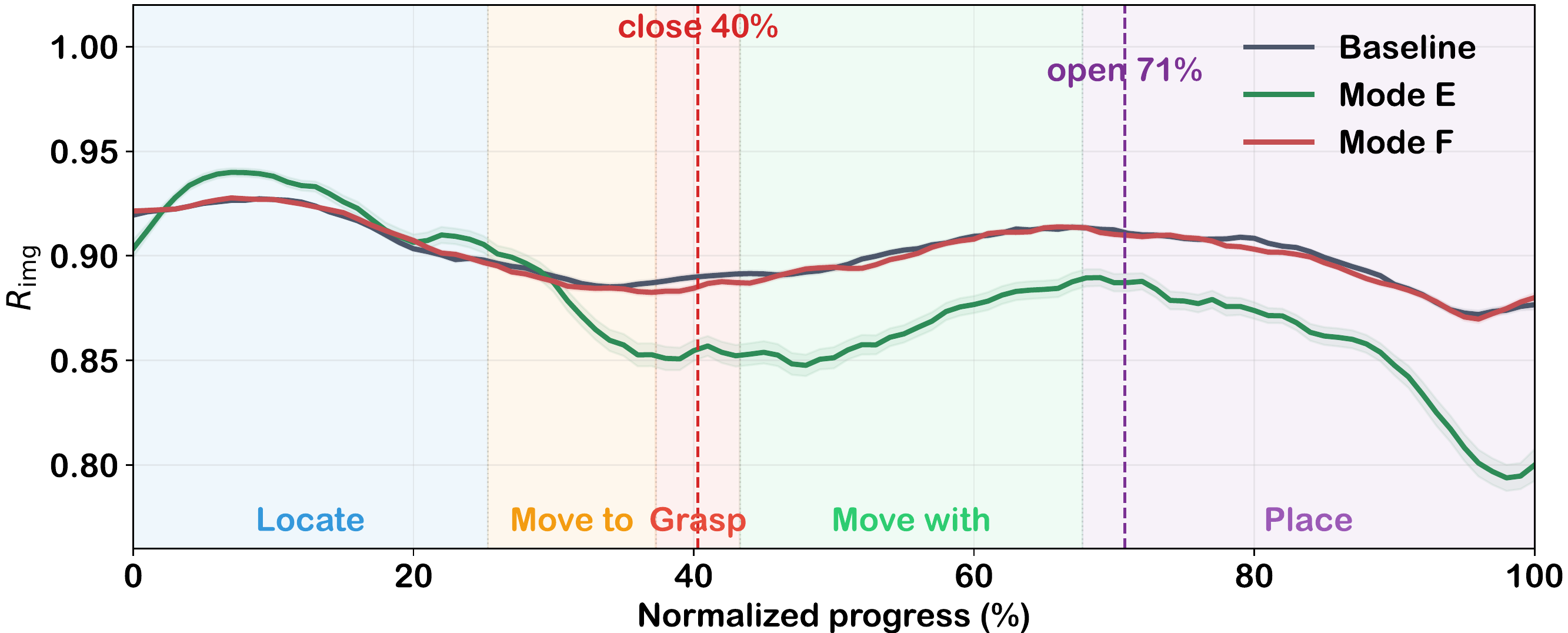
Phase-aligned visual effect ratio on π0.5. The plot reports the visual effect ratio Rimg over task progress for the baseline, Mode E, and Mode F. Dashed vertical lines indicate gripper close and open events.
Within a single task execution, modality effects change with manipulation phases. The baseline Rimg fluctuates with task progress and changes around gripper close/open events, highlighting the need for dynamic adaptation during execution. Visual effect tends to increase during localization and placement, where external scene information is critical, while proprioceptive effect becomes more influential during motion-transition phases.
| Size | Method | Spatial | Object | Goal | Long | Avg |
|---|---|---|---|---|---|---|
| Large (≥4B) | OpenVLA-OFT | 92.60 | 99.20 | 96.20 | 94.60 | 95.65 |
| +IDR | 94.20 | 99.20 | 98.00 | 94.80 | 96.55 | |
| Small (<4B) | π0.5 | 97.50 | 95.00 | 97.00 | 95.50 | 96.25 |
| +IDR | 98.00 | 100.00 | 97.00 | 95.00 | 97.50 | |
| Tiny (<1B) | X-VLA | 92.60 | 99.20 | 98.00 | 94.40 | 96.05 |
| +IDR | 95.00 | 100.00 | 93.00 | 93.00 | 96.50 | |
| VLA-Adapter | 94.20 | 95.60 | 98.00 | 92.60 | 95.10 | |
| +IDR | 97.00 | 100.00 | 96.00 | 94.00 | 96.50 |
IDR consistently improves all four VLA backbones. The largest gains are observed on VLA-Adapter (+1.40) and π0.5 (+1.25), where the visual-effect-guided adaptation provides the most benefit.
| Method | 1/5 | 2/5 | 3/5 | 4/5 | 5/5 | Avg Len |
|---|---|---|---|---|---|---|
| X-VLA | 95.7 | 90.9 | 86.0 | 78.8 | 70.5 | 4.22 |
| +IDR | 98.1 | 94.2 | 89.9 | 84.3 | 77.3 | 4.44 |
| VLA-Adapter | 97.1 | 93.8 | 88.8 | 82.5 | 76.4 | 4.39 |
| +IDR | 97.7 | 94.1 | 89.3 | 83.8 | 77.8 | 4.43 |
On CALVIN, IDR improves both the average completed length (from 4.22 to 4.44) and the 5/5 completion rate (from 70.5% to 77.3%), demonstrating its effectiveness in long-horizon execution.
| Environment | Method | Blocks | Eggplant | Spoon | Place | Avg |
|---|---|---|---|---|---|---|
| Google VM | X-VLA | 98.33 | 97.08 | 71.76 | 57.41 | 81.15 |
| +IDR | 96.67 | 96.67 | 75.92 | 59.26 | 82.13 | |
| Google VA | X-VLA | 86.25 | 83.83 | 60.95 | 59.26 | 75.88 |
| +IDR | 89.63 | 83.80 | 68.10 | 74.07 | 78.90 | |
| WidowX | X-VLA | 75.00 | 100.00 | 100.00 | 100.00 | 93.75 |
| +IDR | 87.50 | 100.00 | 100.00 | 95.80 | 95.83 |
On SIMPLER, the largest gain is achieved in the Variant Aggregation (VA) setting (+3.02), where visually grounded manipulation is particularly critical.
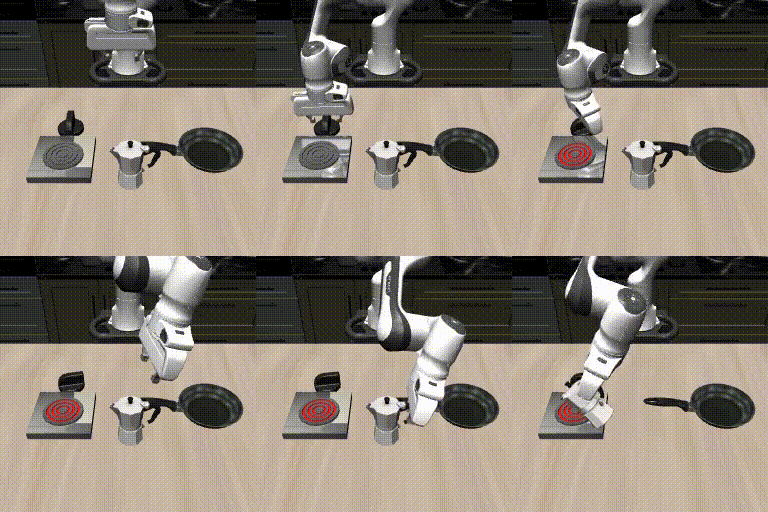
Comparison of baseline (left) vs IDR (right) on LIBERO tasks. Each pair shows failure case without IDR and success case with IDR.
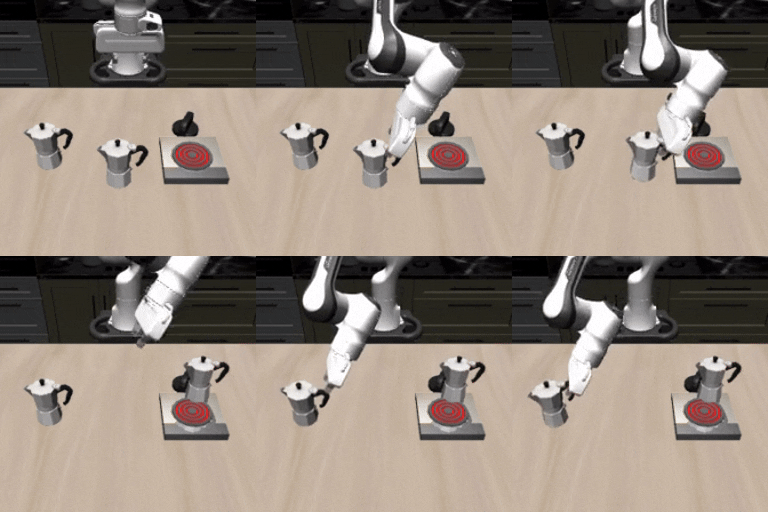
Baseline - Failed
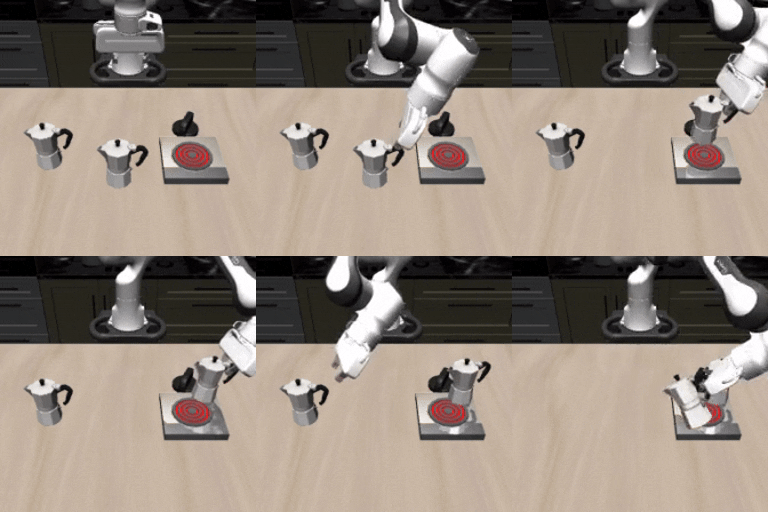
+IDR - Successful
Put both moka pots on the stove
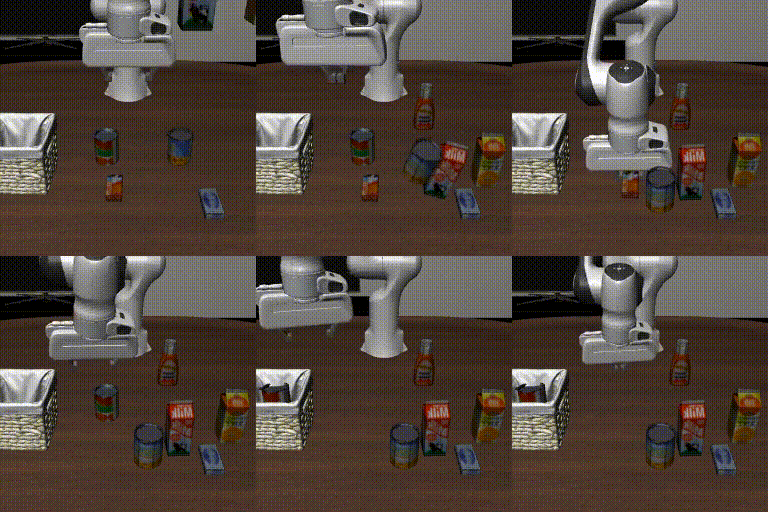
Baseline - Failed
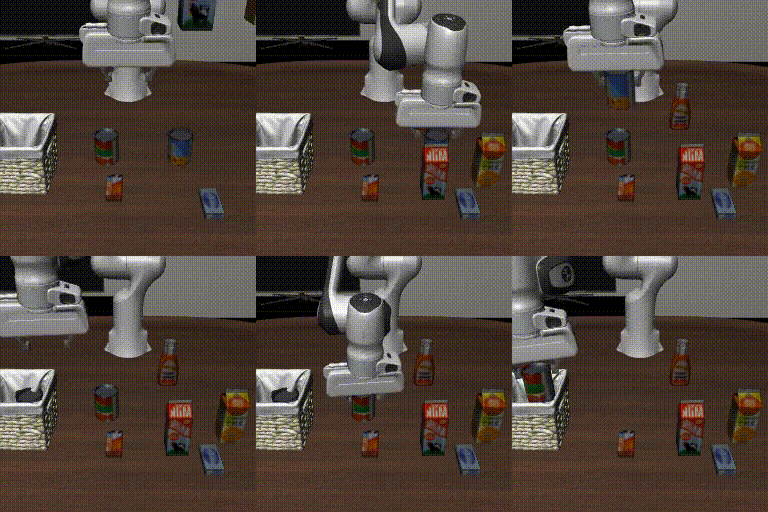
+IDR - Successful
Put both the alphabet soup and the tomato sauce in the basket
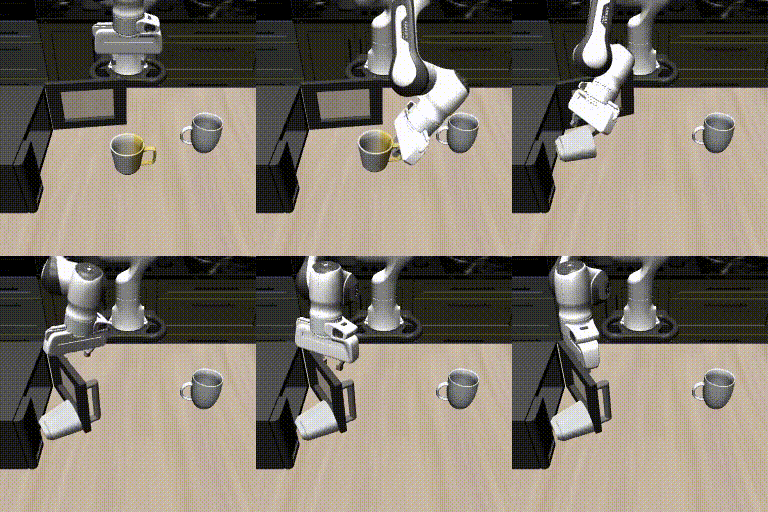
Baseline - Failed
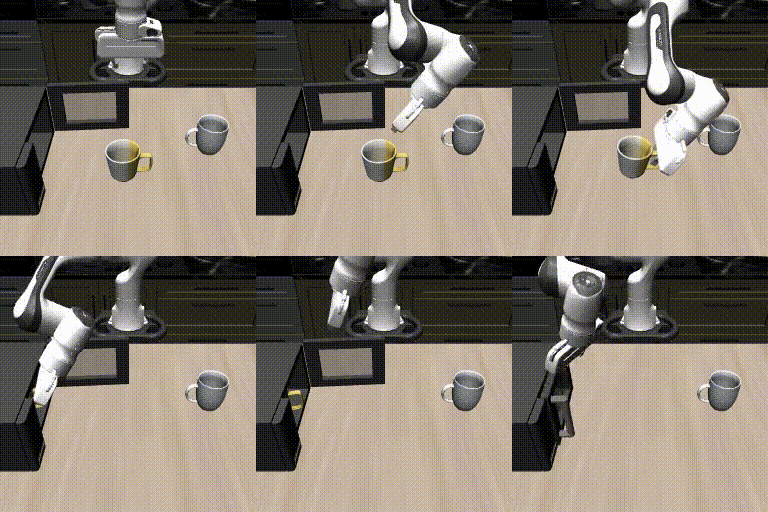
+IDR - Successful
Put the yellow mug in the microwave
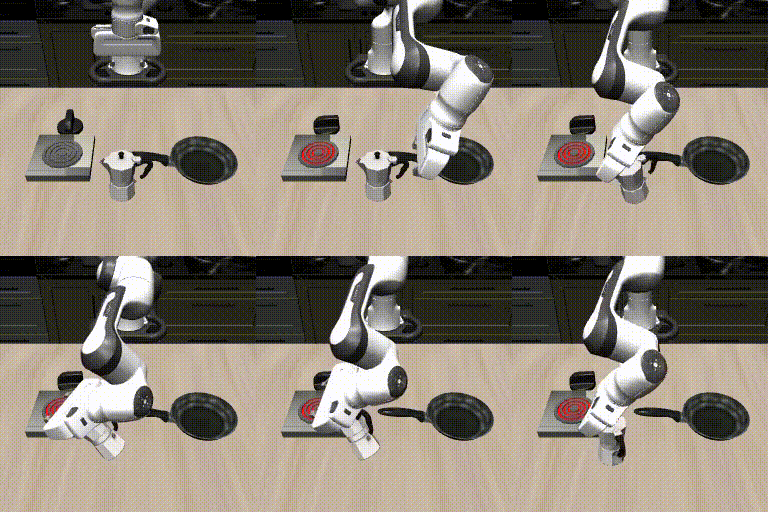
Baseline - Failed
+IDR - Successful
Turn on the stove and put the moka pot on it
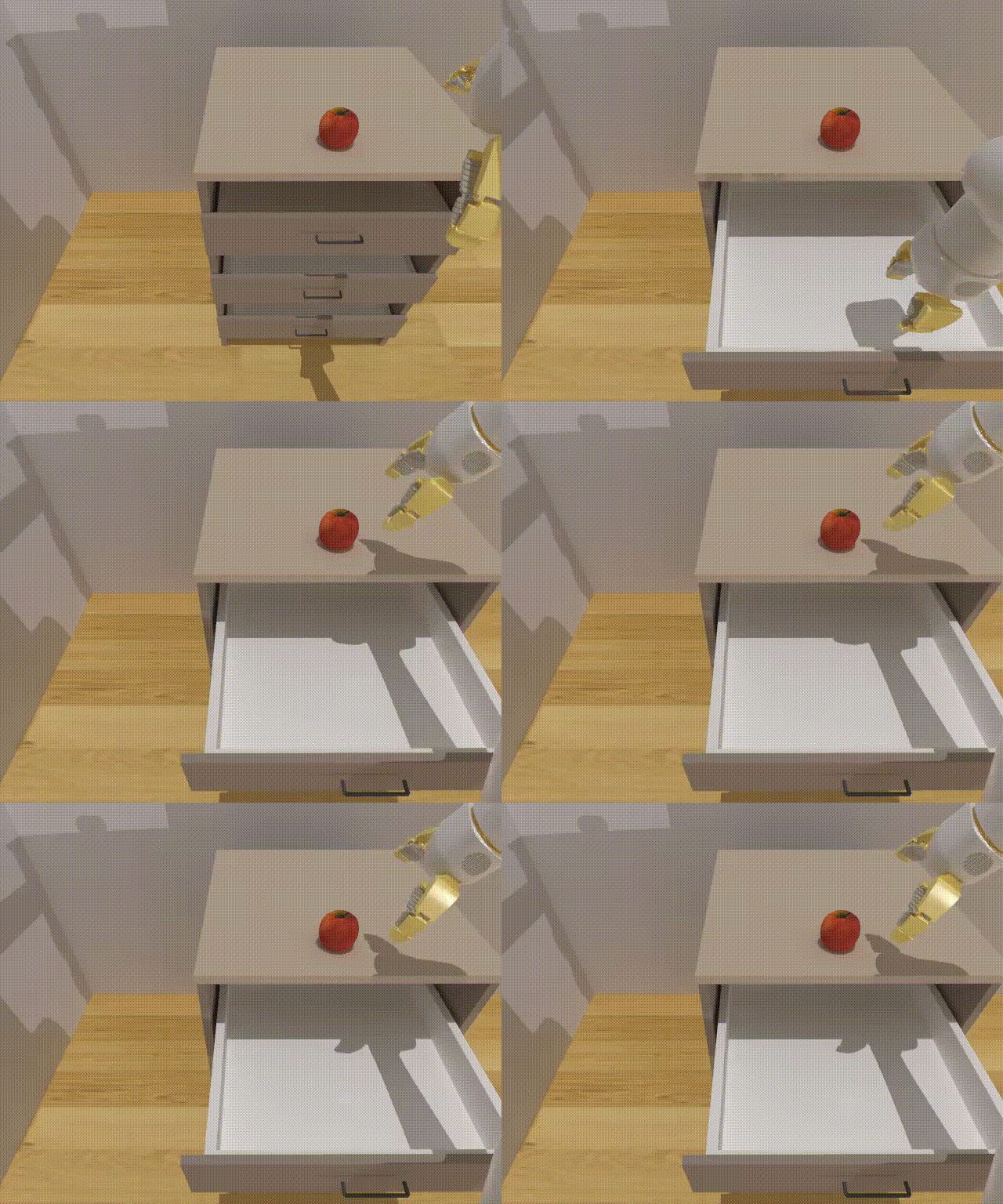
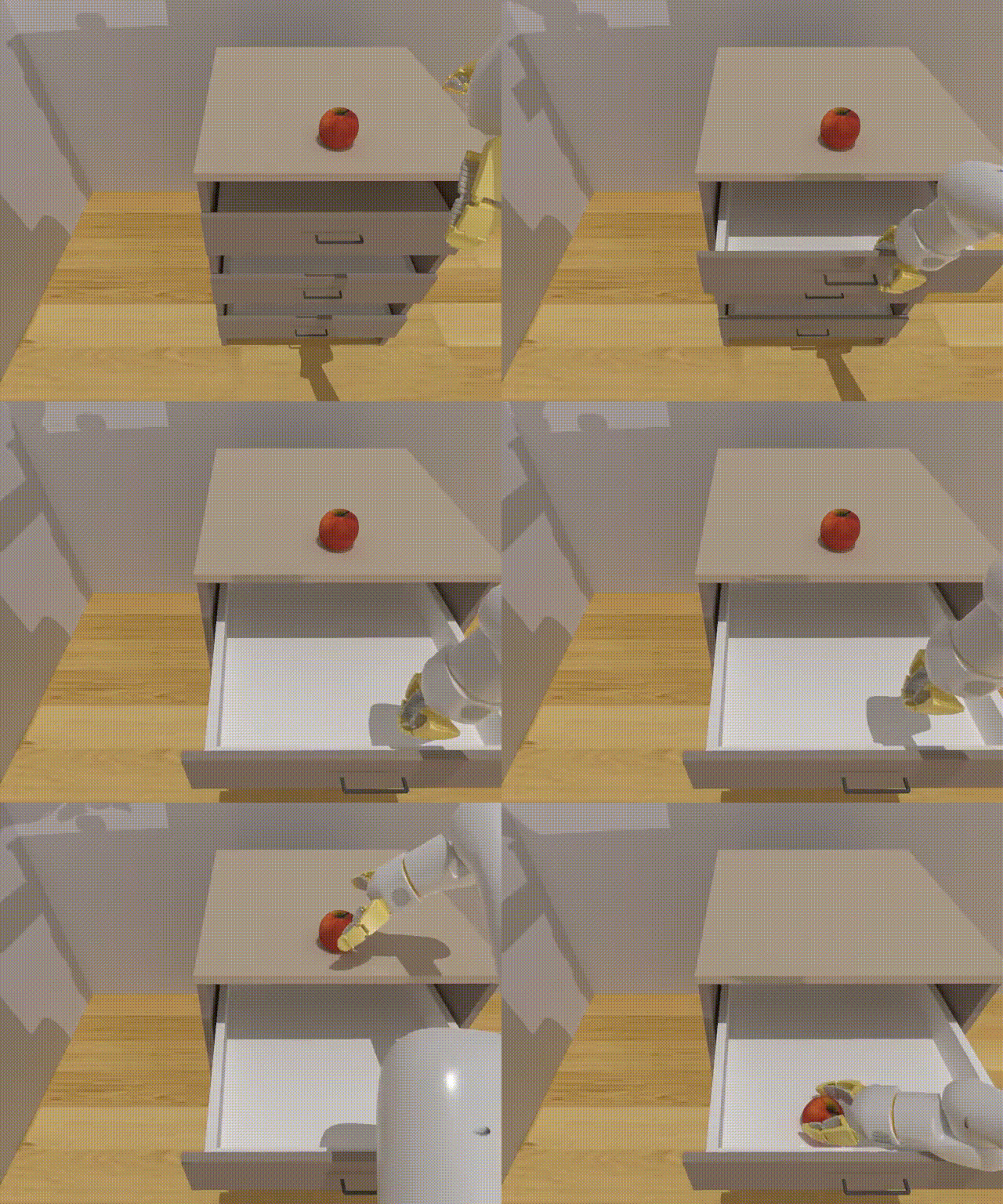
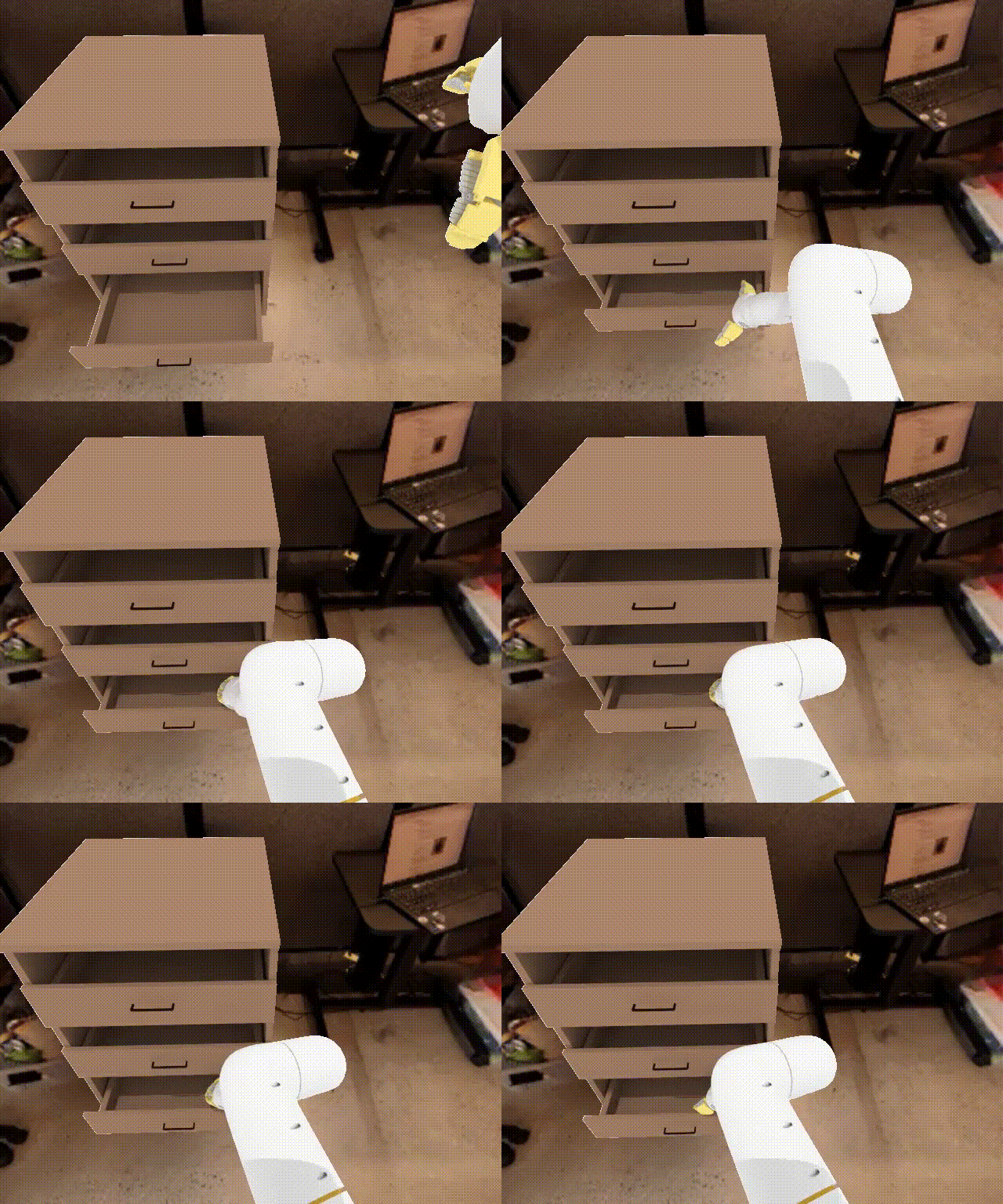
Comparison of X-VLA (left) vs X-VLA+IDR (right) on SIMPLER tasks across different embodiments.
Baseline - Failed
+IDR - Successful
Open top drawer and place coke_can into top drawer
Baseline - Failed
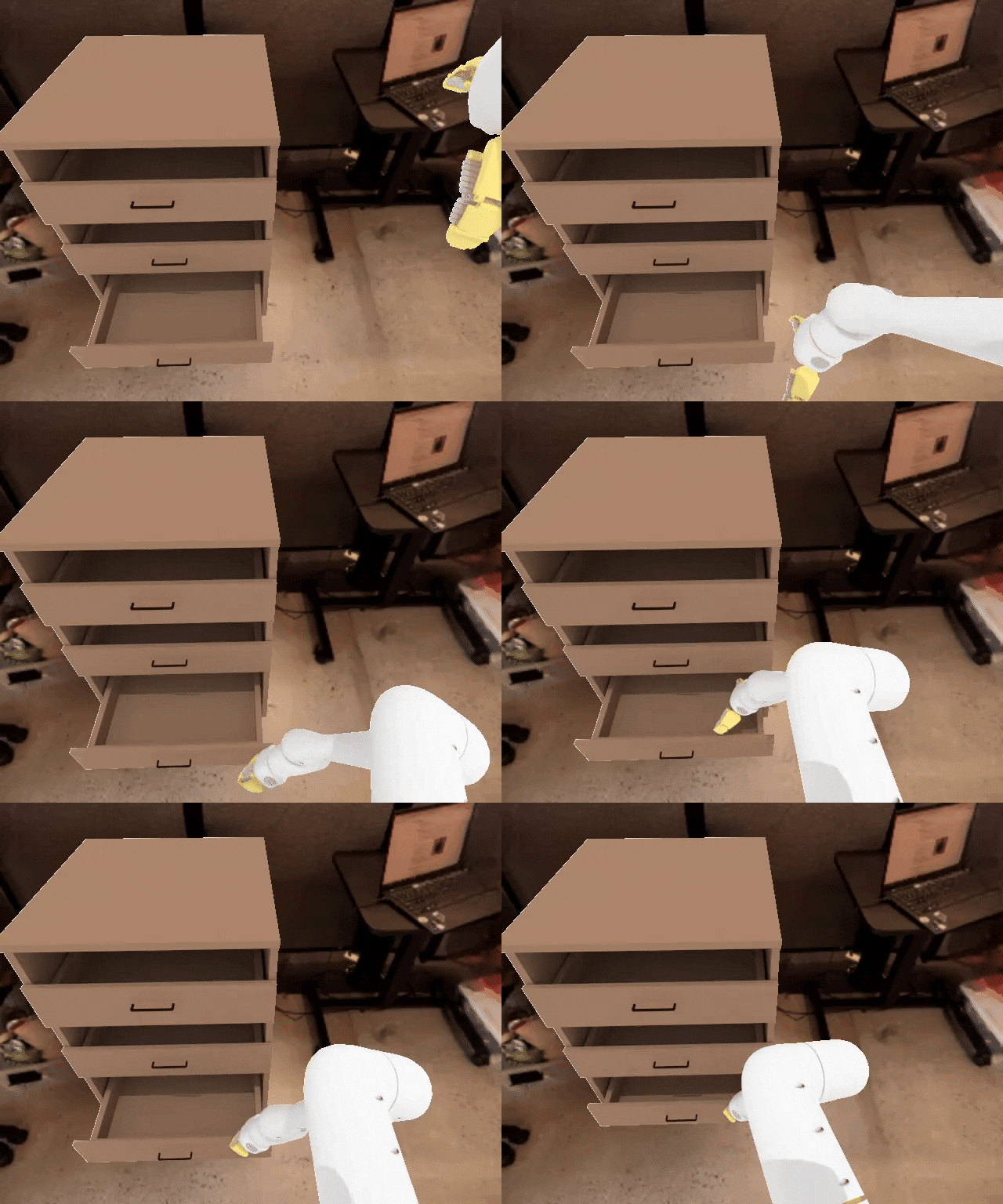
+IDR - Successful
Open and close bottom drawer
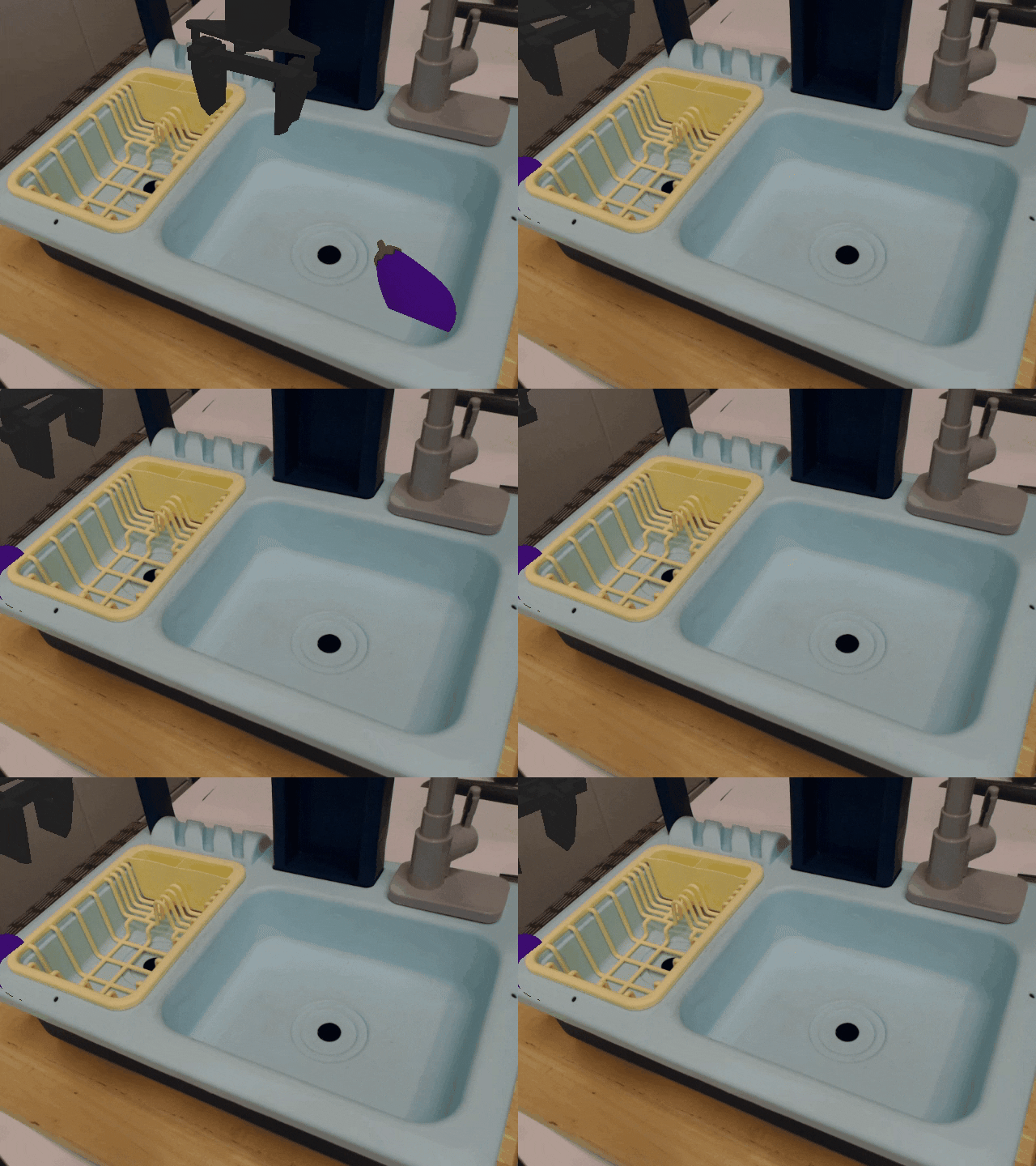
Baseline - Failed
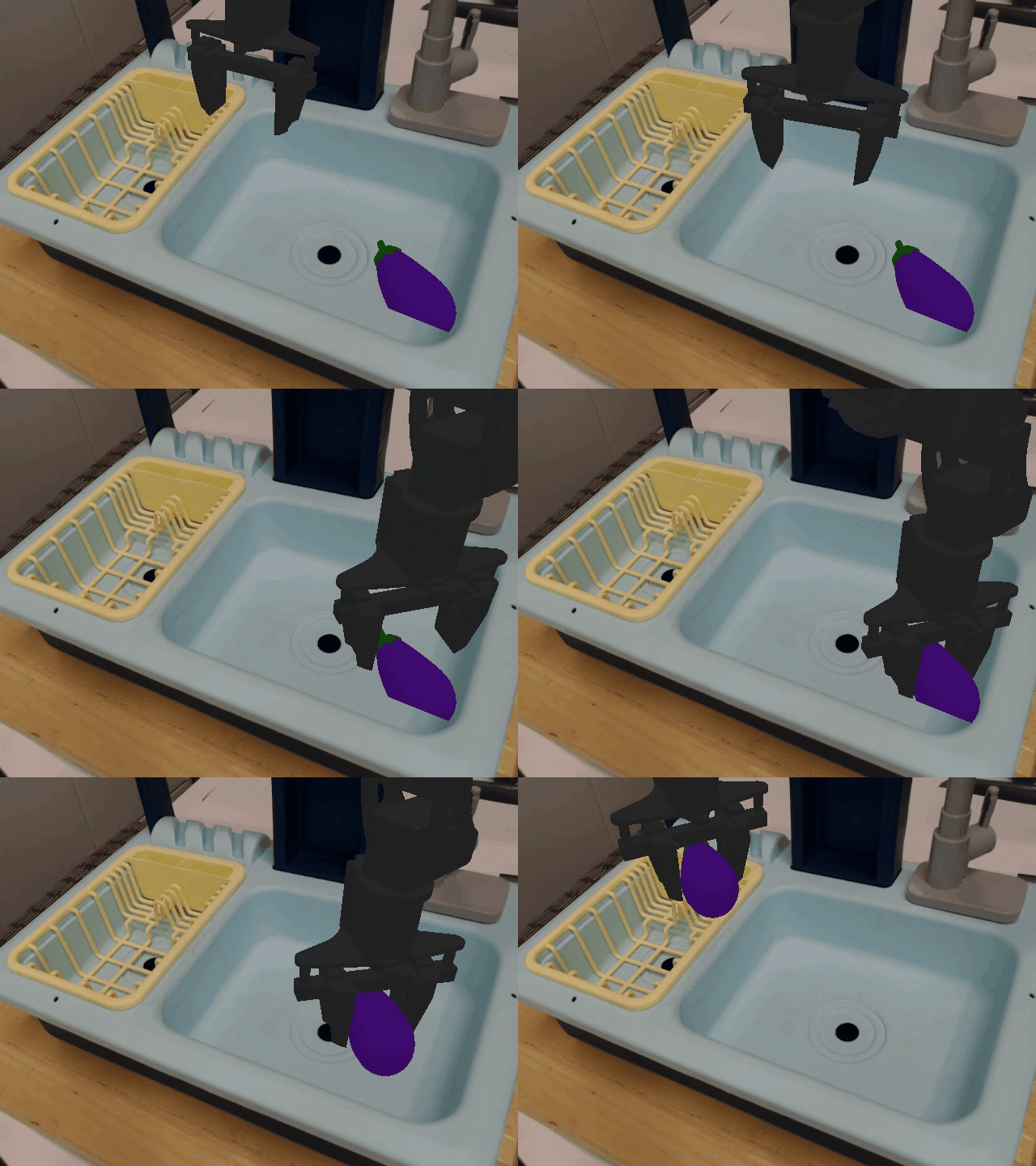
+IDR - Successful
Put eggplant into yellow basket
We evaluate IDR on real-world manipulation tasks using a dual-arm ARX5 platform. The evaluation tasks cover four task categories with different manipulation challenges.
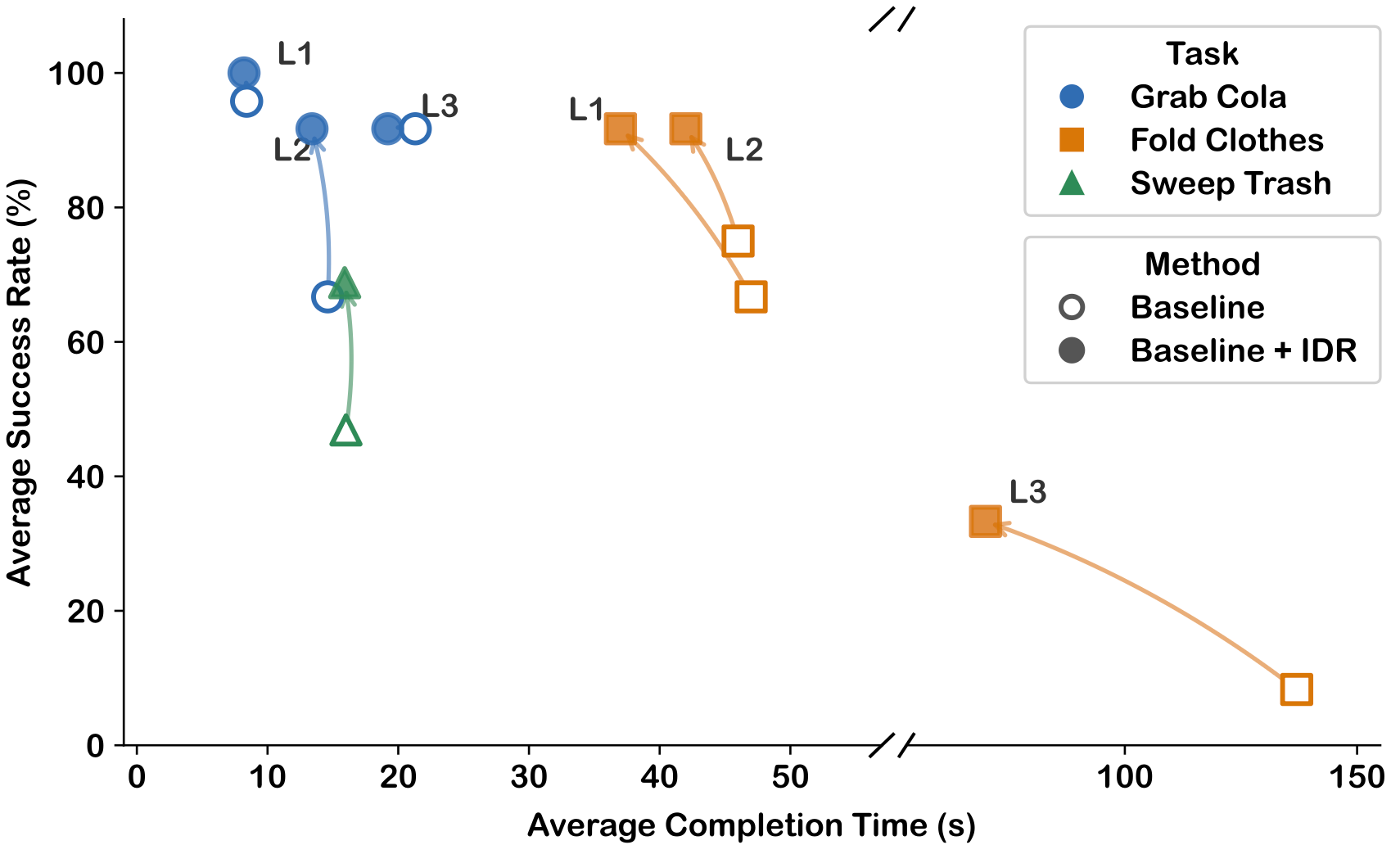
Real-world experiment results on ARX5 dual-arm platform.
| Task | Level | Method | Succ. (%) | Avg. Time |
|---|---|---|---|---|
| Grab Cola | Level 1 | Baseline | 95.8 | 8.4s |
| Ours | 100.0 | 8.7s | ||
| Level 2 | Baseline | 66.7 | 14.3s | |
| Ours | 91.7 | 13.4s | ||
| Level 3 | Baseline | 91.7 | 21.3s | |
| Ours | 91.7 | 19.2s | ||
| Fold Clothes | Level 1 | Baseline | 66.7 | 47s |
| Ours | 91.7 | 37s | ||
| Level 2 | Baseline | 83.3 | 52s | |
| Ours | 91.7 | 47s | ||
| Level 3 | Baseline | 8.3 | 222s | |
| Ours | 33.3 | 155s | ||
| Sweep Trash | — | Baseline | 59.4 | 16.0s |
| Ours | 68.8 | 15.9s |
| Tasks Completed in a Row | ||||||
|---|---|---|---|---|---|---|
| Method | 1/5 | 2/5 | 3/5 | 4/5 | 5/5 | Avg Len ↑ |
| Baseline | 83.3% | 66.7% | 33.3% | 33.3% | 0.0% | 2.167 |
| Ours | 100.0% | 100.0% | 100.0% | 66.7% | 33.3% | 4.000 |
On the challenging 5-step Organize Table task, IDR achieves a 33.3% full-completion rate compared with 0% for the baseline, while increasing the average completed steps from 2.17 to 4.00 out of 5.
Overall, IDR improves manipulation performance across various real-world tasks, particularly on challenging tasks requiring fine-grained visual guidance and contact-rich manipulation.
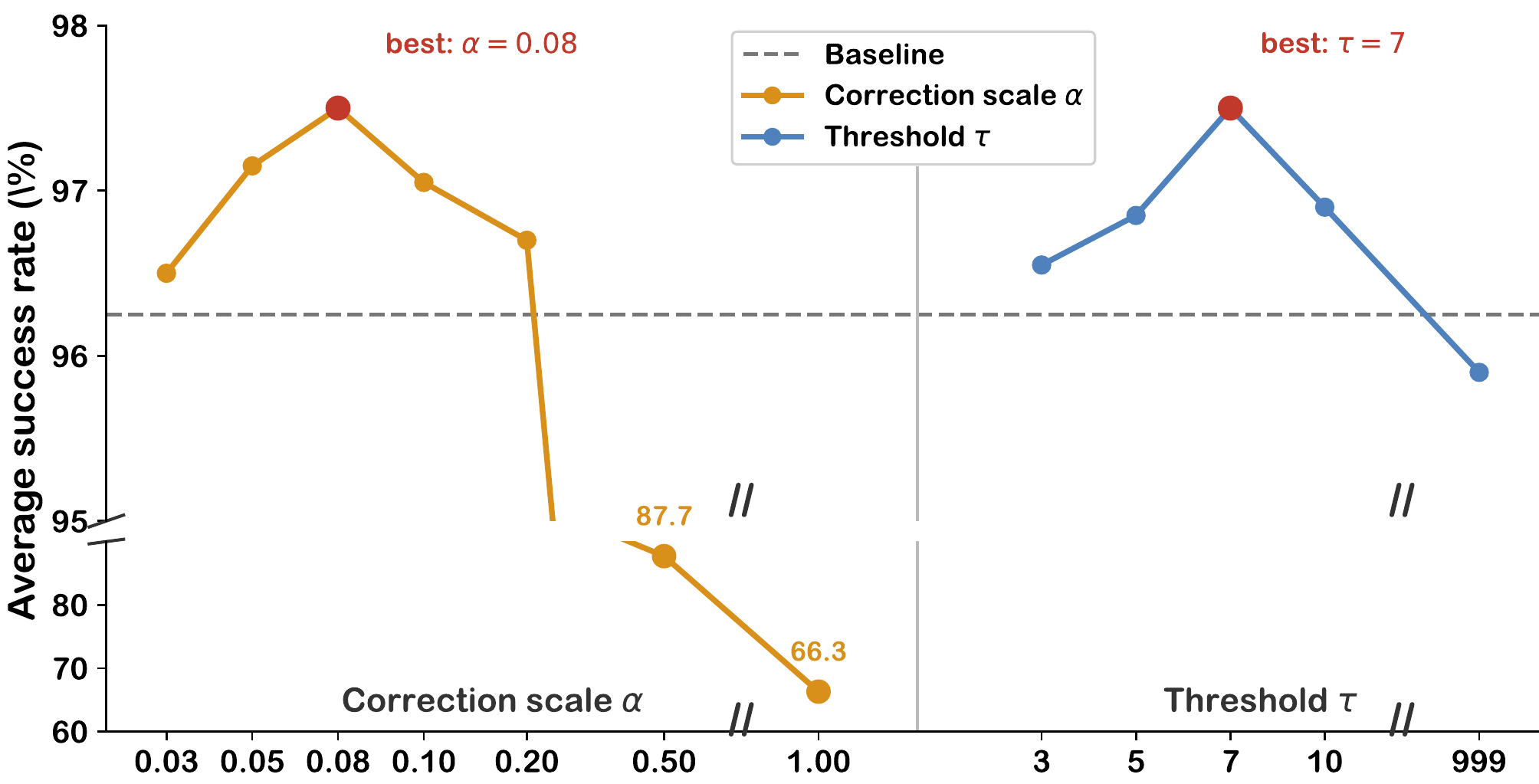
Moderate correction scales and intervention thresholds yield the best performance, while excessive correction or uniform intervention degrades action generation.
Correction scale (α): Performance peaks at α=0.08, while nearby values such as α=0.05, 0.10 produce comparable results. Larger values (α ≥ 0.5) degrade performance, indicating that excessive visual-effect correction can destabilize action generation.
Intervention threshold (τ): Small values rarely activate the gate, and therefore provide limited improvement. Uniform intervention with τ=999 performs below the baseline. The best performance is obtained at τ=7, where refinement is applied only to predictions with low diagnosed visual effect.
Side-by-side comparison of baseline (left) and IDR (right) on real-world tasks using a dual-arm ARX5 platform. Videos are shown at 2× speed.
Baseline - Failed
+IDR - Successful
Deformable object manipulation — fold clothes
Baseline - Failed
+IDR - Successful
Contact-rich sweeping — sweep trash into a dustpan
Baseline - Failed
+IDR - Successful
Bimanual coordination — grab and transfer a cola can
Baseline - Failed
+IDR - Successful
Long-horizon sequential — place 5 objects into a drawer
@article{zhang2026causality,
  title={A Causality-aware Infer-diagnose-refine Framework for Test-time Modality Adaptation in VLA Models},
  author={Zhang, Haoyu and Wu, Yuwei and Chen, Jin and Zhi, Gao and Diao, Zhenxin and Gao, Mingyang and Wu, Kun and Liu, Yongchun and Li, Fan},
  journal={arXiv preprint arXiv:2607.25516},
  year={2026}
}